- Please tell us about yourself and your work at ICA Foundation Kenya:
Winny: My name is Winny Ouma, and I am the Founding Director of Innovators 4 Climate Action (ICA)
Foundation Kenya, a feminist, LBQ-led climate justice organization working across coastal Kenya. ICA was established to respond to a gap we consistently observed where Queer women and non-binary people are disproportionately impacted by climate shocks, yet remain largely invisible in climate data, humanitarian response systems, and policy design.
Our work sits at the intersection of climate justice, gender justice, economic justice, and human rights. We design community-rooted programmes that combine immediate resilience building with long-term systems change. This includes ecological farming and food security, climate literacy and leadership development, feminist research and storytelling, community-led anticipatory action and emergency response during climate shocks and digital skills and climate innovation.
Alongside programme delivery, I engage in national, regional, and global climate policy spaces, including the UNFCCC Women and Gender Constituency (Intersectional Queers sub-group), advocating for inclusive climate finance, rights-based climate governance, and the meaningful inclusion of queer and gender-diverse communities in climate decision-making.
2. Why is data at the intersection of gender and environment/climate important to ICA Foundation Kenya?
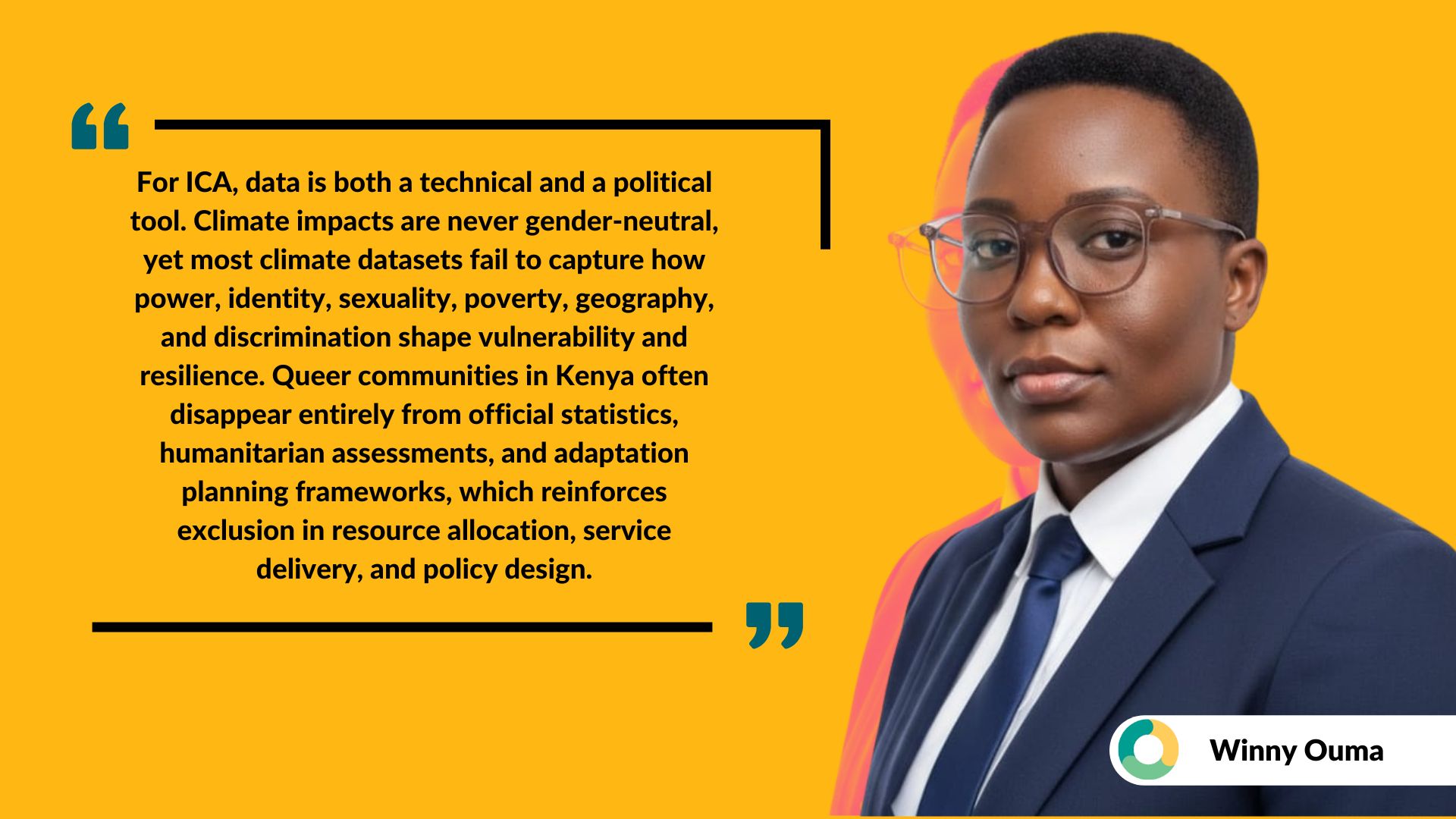
Winny: For ICA, data is both a technical and a political tool. Climate impacts are never gender-neutral, yet
most climate datasets fail to capture how power, identity, sexuality, poverty, geography, and discrimination shape vulnerability and resilience. Queer communities in Kenya often disappear entirely from official statistics, humanitarian assessments, and adaptation planning frameworks, which reinforces exclusion in resource allocation, service delivery, and policy design.
We use gender- and climate-responsive data to make invisible impacts visible, including how climate-driven food insecurity affects queer households differently, how displacement increases exposure to violence and healthcare exclusion, how loss of livelihoods deepens economic precarity for LBQ women, and how digital access can unlock alternative income pathways.
Our programmes intentionally integrate participatory data collection, community storytelling, baseline and endline surveys, and feminist monitoring approaches that center lived experience alongside quantitative indicators. Good data allows us to advocate credibly, design better interventions, attract responsible funding, and hold systems accountable. Equally important, we see data as a tool for community empowerment that enable people to understand their own realities, articulate evidence-based demands, and co-create solutions rooted in dignity and justice rather than deficit narratives.
3. What inspired ICA Foundation Kenya to become part of GEDA?
Winny: GEDA’s commitment to feminist, intersectional, and justice-centered data resonated deeply with our values and practice. Much of the existing climate data architecture remains extractive, top-down, and disconnected from grassroots realities, particularly in the Global South. As a growing organization, ICA was seeking a learning and solidarity ecosystem where evidence generation, policy influence, and movement building are intentionally linked.
Joining GEDA allows us to both contribute and learn, share insights from working with Queer communities in climate-vulnerable contexts, to strengthen our own methodological rigor, and to collaborate with actors who are advancing gender-responsive climate data globally. We were also drawn to GEDA’s emphasis on bridging research and action, ensuring that data informs real policy shifts, funding decisions, and accountability mechanisms rather than remaining confined to academic or technical spaces.
Being part of GEDA strengthens our ability to position Queer-inclusive climate data as a legitimate and necessary part of gender and environment discourse, and to amplify voices that are often excluded from mainstream datasets.
4. What are you looking forward to in terms of gender and environment data this year (or what really inspired you this year)?
Winny: This year, we are excited about advancing more community-driven and intersectional data practices that move beyond binary gender analysis and surface the realities of marginalized groups. At ICA, we are deepening our feminist knowledge production through expanded documentation of queer climate impacts, livelihood pathways, and resilience strategies emerging from our ecological farming and digital innovation programmes.
We are also eager to see stronger alignment between gender-responsive data and climate finance accountability that will ensure funding flows are guided by evidence on who is most impacted, who is being excluded, and what interventions generate meaningful outcomes over time. Improved integration of qualitative data, lived experience narratives, and localized indicators into national and global reporting systems would significantly strengthen equity in climate governance.
Within the GEDA community, we look forward to learning from peer organizations, contributing grassroots perspectives to global datasets and dialogues, and strengthening partnerships that translate data into policy influence, movement building, and tangible benefits for frontline communities.
5. Is there a specific resource you’d like to share with the GEDA Insights Network?
Winny: We are currently finalizing a research a forthcoming report and position paper analyzing Kenya’s Nationally Determined Contributions (NDCs) through a feminist, queer-inclusive, and climate justice lens. The publication examines gaps in gender responsiveness, data inclusion, and accountability, and proposes concrete policy and financing recommendations to strengthen equity and implementation.
The report and position paper will be officially launched in mid-February. Due to publication timelines, we may not be able to share these resources within this first-quarter edition of GEDA Insights. However, we would be very happy to share them with the GEDA network in the second quarter once the launch process is complete.