Each year, GEDA supports projects that explore feminist, grassroots, and community-based quantitative and qualitative data collection methodologies, with an emphasis on locally-led and participatory approaches. While some projects may generate new data to fill existing gaps, others may strengthen capacity, raise awareness, or illustrate best practices to catalyze greater uptake and use of quality data and knowledge for gender-transformative environment and climate action.
Objectives
By supporting local, community-based organizations primarily in the Global South, GEDA’s Small Grants Program:
Overall, the program contributes to GEDA’s efforts to advance systemic, gender-transformative shifts in policy, programming, financing, and planning through data, primarily by elevating the work of grassroots, feminist, and community-level organizations.
Meet Our 2025-2026 Grantees
The Gender and Environment Data Alliance (GEDA) Secretariat and Steering Committee is excited to announce the recipients of the 2025-26 round of GEDA Small Grants! This year, GEDA awarded eleven grants to organizations around the globe working on participatory and inclusive approaches to collecting, analyzing, and using gender-environment data.
Hover over each highlighted country to see our grantees!
Our grantees work on projects focused on a diverse range of issues using innovative and community-focused approaches. Learn more about each recipient and their project by clicking on their name.
The Center for Urban Studies (CEURB) of the Federal University of Minas Gerais (UFMG) is dedicated to interdisciplinary research and public policy analysis on urban mobility, accessibility, social inequality, and participatory planning. The Center coordinates projects that engage communities, local governments, and academic networks to promote inclusive, sustainable cities.
Project: Equality in motion: Gender, Climate Vulnerability, and the BRT Amazonas in Belo Horizonte
This project seeks to generate participatory, gender-sensitive data on how women experience climate-related vulnerabilities while using the Bus Rapid Transit (BRT) system in Amazonas Avenue corridor in Belo Horizonte, Brazil. Using a mixed-methods approach, including sensors, GPS tracking, participatory cartography, mobile methods, and interviews, the research will identify environmental risk areas such as heat stress zones, poor lighting, and flood-prone segments.
 DASTAK Women Rights and Awareness Foundation is a feminist non-profit and a survivor-led movement advancing feminist gender, climate justice, and transformative change in sexuality, gender, health, and rights. DASTAK ensures that grassroots struggles inform global advocacy while securing equitable access to resources for communities on the frontlines of injustice.
Project: Movement, Memory, and Solidarity in Mountains: A Care-Centred Feminist Participatory Atlas of Climate Displacement, Sexual and Reproductive Health and Rights, and Well-being in Chitral Upper, Pakistan
This project will generate a comprehensive and community-owned evidence base on the scale, nature, and impacts of climate-induced displacement in Upper Chitral, with a specific focus on women, youth, and persons with disabilities. A key outcome will be the creation of a detailed database documenting displaced households, migration patterns, and associated economic and non-economic losses, including the erosion of livelihoods, care networks, and ecological resources.
Environment Conservation Organization for Afghanistan (ECOFA) aims to establish a developed educational environment for men and women; improve agricultural knowledge to allow agriculture business to become more profitable, efficient, safer and more environmentally friendly; develop irrigation systems; and provide social services to disadvantaged, distressed, or vulnerable communities.
Project: Data Collection for Gender, Water, and Climate Mobility in Central Afghanistan
This project builds and expands on their 2024-25 grant to implement gender-responsive, participatory data collection to address the intersection of climate change, water insecurity, and climate-induced displacement. The overall objective is to empower the local community, particularly women, to advocate for inclusive policy reform using localized, gender-sensitive data.
 Fundación Plurales supports and strengthens communities and organizations of activists and environmental and land defenders in their efforts to protect people and the ecosystems essential for life in the Global South.
Project: Data for Advocacy: Strengthening Feminist Leadership for Environmental Justice in Latin America
This project aims to train and support rural and Indigenous women and youth across Latin America in the strategic use of both official and citizen-generated data to influence gender-responsive environmental public policies. Through a regional virtual course and a practical stage supported by seed funding, 30 women leaders will be trained in participatory methodologies to collect, analyze, and translate data into concrete monitoring and advocacy tools.
 Greenergy Pacific aims to build Climate Smart Villages (CSVs) in the Solomon Islands & the Pacific Region. Through their work they hope to serve and save their people & their Islands through climate smart mitigation & adaptation solutions.
Project: BOLD (Building Opportunities, Lifting Dreams) Project
This project will empower single mothers in the Solomon Islands by equipping them with the knowledge, tools, and support to lead in environmentally sustainable livelihoods while addressing the social and economic vulnerabilities they face. It will fill a critical data gap about the environmental challenges experienced by single mothers from rural communities in the Solomon Islands and will use that data to advocate for local policy change.
 ICEG’s mission is to empower African communities and promote sustainable climate and environmental governance through cutting-edge research, advocacy, and collaboration with key stakeholders, so as to create a sustainable future for all.
Project: Gendered Pathways of Climate Mobility: Documenting Women’s Experiences of Climate-Induced Migration in Ghana’s Coastal-Northern Migration Corridor
This project will explore how climate change shapes migration among women in Ghana’s vulnerable coastal and northern regions. It will examine gendered patterns of climate-induced mobility between origin communities (Keta, Ada, Tamale) and urban destinations (Accra, Tema) and aims to analyze intersectional vulnerabilities, highlight women’s agency and coping mechanisms, and map both barriers and support systems.
 JVE-Benin works to create a protected living environment where everyone, regardless of their status, can live with dignity and actively contribute to preserving the environment. Its mission is to support the capacities of actors at all levels, particularly women and young people, in order to make them resilient and capable of playing their full role in safeguarding their living environment.
Project: Data for Women: Co-producing women’s data for climate adaptation in Benin
This project aims to fill the gap in gendered and local data on climate vulnerability in rural areas of southern Benin. By directly involving rural women and young girls in the co-production of qualitative and quantitative data, the project will document the specific obstacles they face in the face of climate change and promote their endogenous adaptation strategies.
 La Ruta del Clima is an NGO that promotes public participation in climate and environmental decision-making, through education, awareness, training and communication on climate change in Latin America. The focus of their work is climate impacts, justice, human rights, community data and loss and damage.
Project: P51 with a Gender Perspective: Transformative Data from the Communities
This project will integrate the gender modules developed through participatory processes during Phase I—made possible by GEDA’s first grant—into La Ruta del Clima’s Loss and Damage Monitoring and Reporting System (P51). This will strengthen both the application and the qualitative data collection methodology by incorporating gender-sensitive tools that make visible the structural inequalities underlying climate impacts.
 One Future Collective exists to advance a world built on social justice, led by communities of care, through catalysing people-power and just institutions. They work to promote the rights of women and queer folks in India and South Asia and do so through leadership development and healing and justice services; research and advocacy; and 1:1 partner support to partners seeking to promote gender equality and social justice within their organizations.
Project: Making Visible the Invisible: Confronting Climate’s Hidden Toll on Women and Queer Workers in India’s Development Sector
This project will generate intersectional, gender-environment data on how climate change is impacting the health, safety and overall well-being of women and gender-marginalised persons employed within India’s development sector. The findings from this study will be used to organise the demands of development sector workers while presenting evidence of best practices for funders and organisational leaders.

OK Kit created a local data economy model as a new economic and governance system to stabilize data, funding and revenues for women and local communities. Instead of slow grant systems with a 90% rejection rate, and siloed cross-sector efforts, research, policy and program development are coordinated by location and transformed into direct impact models. Starting at 3 months, frugal science, local knowledge and civic technology produce economic, social and environmental outcomes for the dignity and equity of local communities.
Project: Gender + Local Data Economy Model in Indonesia
This project will train 100 Indonesian women as local data collectors to complete a gender gap mapping study across the 17 SDGs, but with more effective geospatial indicators. Hyperlocal data collection and 17 free and open source tools enable up to $100 hourly data wages to produce faster, higher quality, verifiable and representative data at scale. Data outcomes enable local community data to lead the continuous cross-sector prioritization, coordination and monitoring of investments, with greater governance and accountability.
 Women of the Arctic (WoA) aims to raise awareness of, support for, and maintain a focus on women’s and gender-related issues in the Arctic.
Project: YES/AND: Inclusive Pathways for Arctic Environmental Data Justice
This project is focused on improving the International Arctic Observing Assessment Framework, a framework to improve environmental data in the region through the lens of societal benefits like disaster preparedness and food security. While it outlines more than 160 societally-relevant key objectives, it doesn’t include a single reference to gender. Informed by feminist evaluation, and feminist and Indigenous data principles, WoA proposes to convene diverse focus groups to proactively seek perspectives on gender, Indigeneity and their intersections, which were excluded from the original framing. This work will investigate the implications of these missing perspectives and develop feedback toward inclusive planning tools for Arctic regional resilience.

The second round of grants was made possible through core funding from the Swedish International Development Cooperation Agency (SIDA), a two-year grant from the Australian Government through the Climate Resilient Communities facility within the Department of Foreign Affairs and Trade, and targeted funding from Deutsche Gesellschaft für Internationale Zusammenarbeit (GIZ).
Meet Our 2024-2025 Grantees
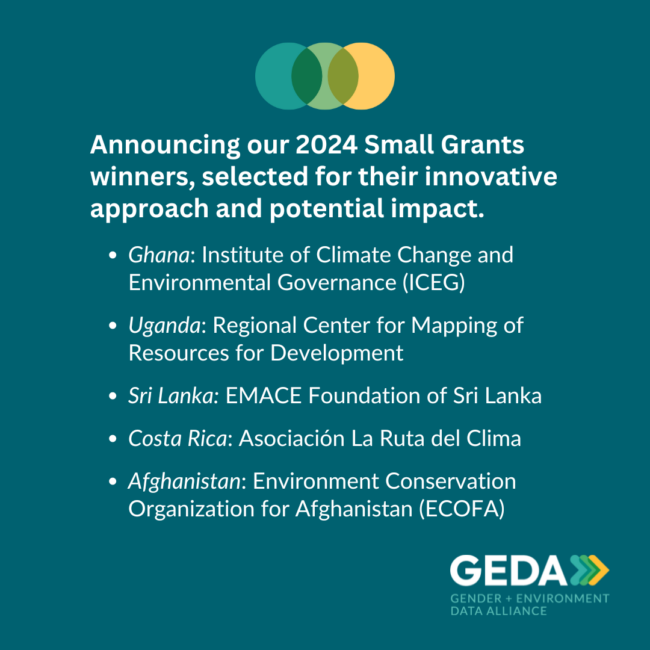 Read more about GEDA’s first Small Grants recipients here, and stay tuned for upcoming snapshots of the projects and impact of this first cohort (October 2024-September 2025)!